



2026 I-SEED Award Honorable Mention
Alaska Design Collaboratory
New approaches to supporting Indigenous communities facing the accelerating impacts of climate change
Description
The Alaska Design Collaboratory is a collaborative research initiative between Virginia Tech, Portland State University, and Colby College working with the Cold Climate Housing Research Center and community partners in the Alaska Native villages of Quinhagak and Unalakleet. Together, the team is exploring new approaches to supporting communities facing the accelerating impacts of climate change, including erosion, flooding, permafrost degradation, housing insecurity, and, in some cases, displacement from their ancestral homelands.
Rather than designing predetermined architectural solutions, the project asks a different question: How can design create the conditions for communities to lead their own adaptation planning?
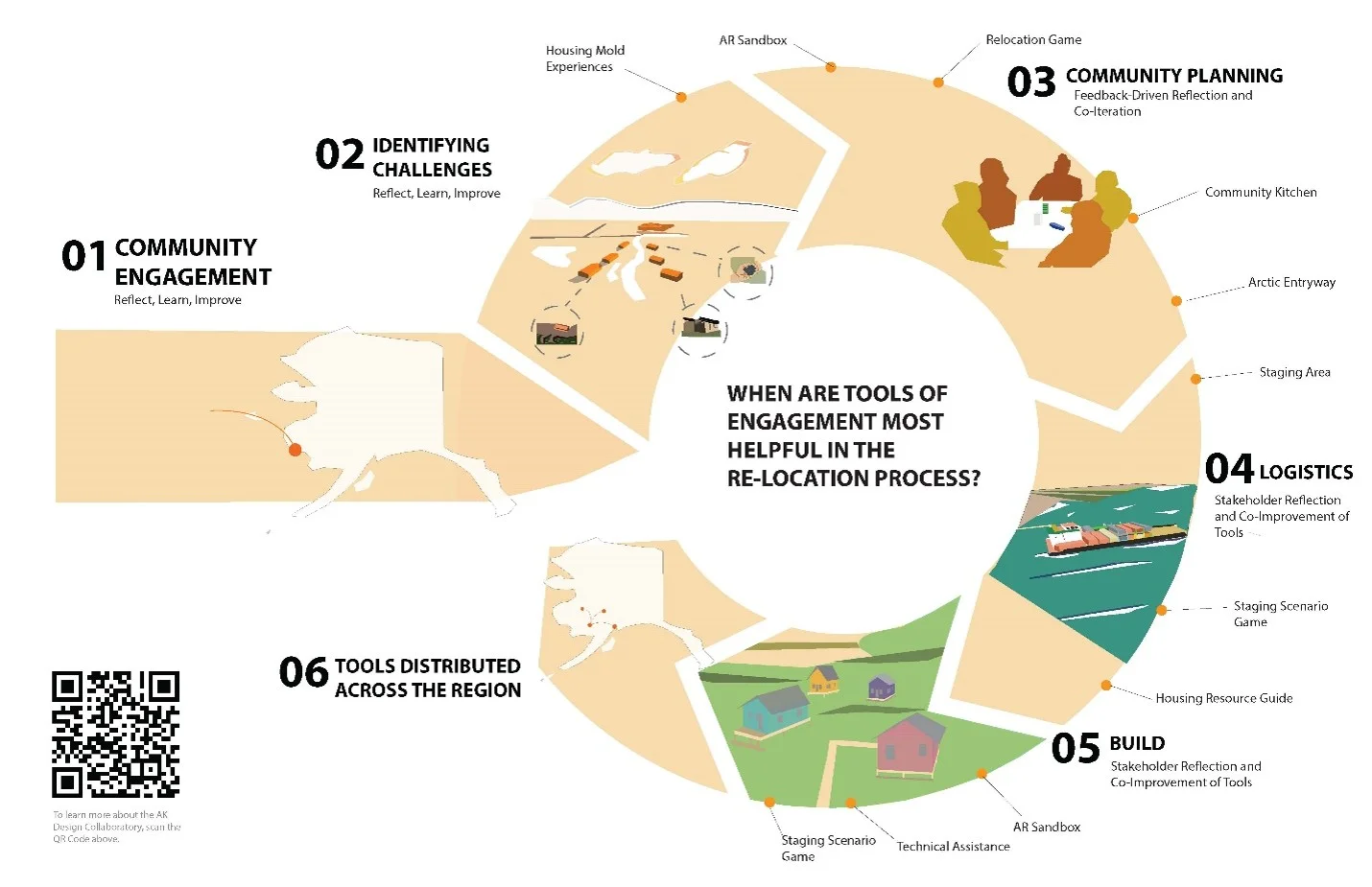
The result is a collaborative design methodology that centers Indigenous knowledge while integrating technical expertise through a family of participatory design tools. Developed through ongoing collaboration with community members, the methodology transforms adaptation planning from a primarily expert-driven process into one that enables residents to identify challenges, explore alternatives, build consensus, and access technical resources while remaining grounded in local knowledge, lived experience, and community priorities.
The project includes complementary tools that support different stages of the decision-making process, including cooperative planning games, augmented reality landscape modeling, scenario planning activities, and analog and digital resource guides. While each tool addresses a specific aspect of climate adaptation, together they form an integrated framework that supports community-led planning, relocation, sheltering in place, and long-term resilience.
The innovation of the Alaska Design Collaboratory lies not in any single tool, but in the methodology that connects them. By creating multiple pathways for participation, the project enables people of different ages, experiences, and technical backgrounds to contribute meaningfully.
Stakeholders
Institutions: Colby College – Dr. Todd Nicewonger, Portland State University – Todd Ferry & Sergio Palleroni; Virginia Tech – Dr. Lisa McNair; Community Researchers/Consultants: Stacey Fritz, PhD, Jerilyn Kelly, Kari Mejorado, Ryan Tinsley, Gundy Cloud, Daniel Bird Tobin
Design Team
Center for Public Interest Design, Portland State University: Todd Ferry, Sergio Palleroni, Ron Janus Acob, Gabriella Werner, Anthony Westwolf; Colby College: Dr. Todd Nicewonger; Virginia Tech, Dr. Lisa D. McNair; Community Partners: Jerilyn Kelly, Kari Mejorado, Ryan Tinsley, Gundy Cloud, Daniel Bird Tobin
Jury Summary
The Alaska Design Collaboratory is an Indigenous-centered initiative addressing climate-driven housing insecurity, disrupted access to traditional foods, and displacement in Alaska Native villages. Through a tri-university partnership with communities including Quinhagak, the project shifts adaptation planning away from predetermined outside solutions toward locally directed decision-making grounded in Indigenous knowledge, lived experience, cultural continuity, and sovereignty. Relocation-planning games, augmented-reality landscape models, storytelling, dialogue, housing resource guides, and interdisciplinary technical support create accessible ways for elders, youth, and other residents to identify challenges, explore alternatives, build consensus, and guide climate-resilience planning. Its process-oriented methodology could strengthen local capacity and support communities throughout the Yukon-Kuskokwim Delta and beyond.