



2026 I-SEED Award Winner
Community Ground
A new education platform built by and for a rural Senegalese community
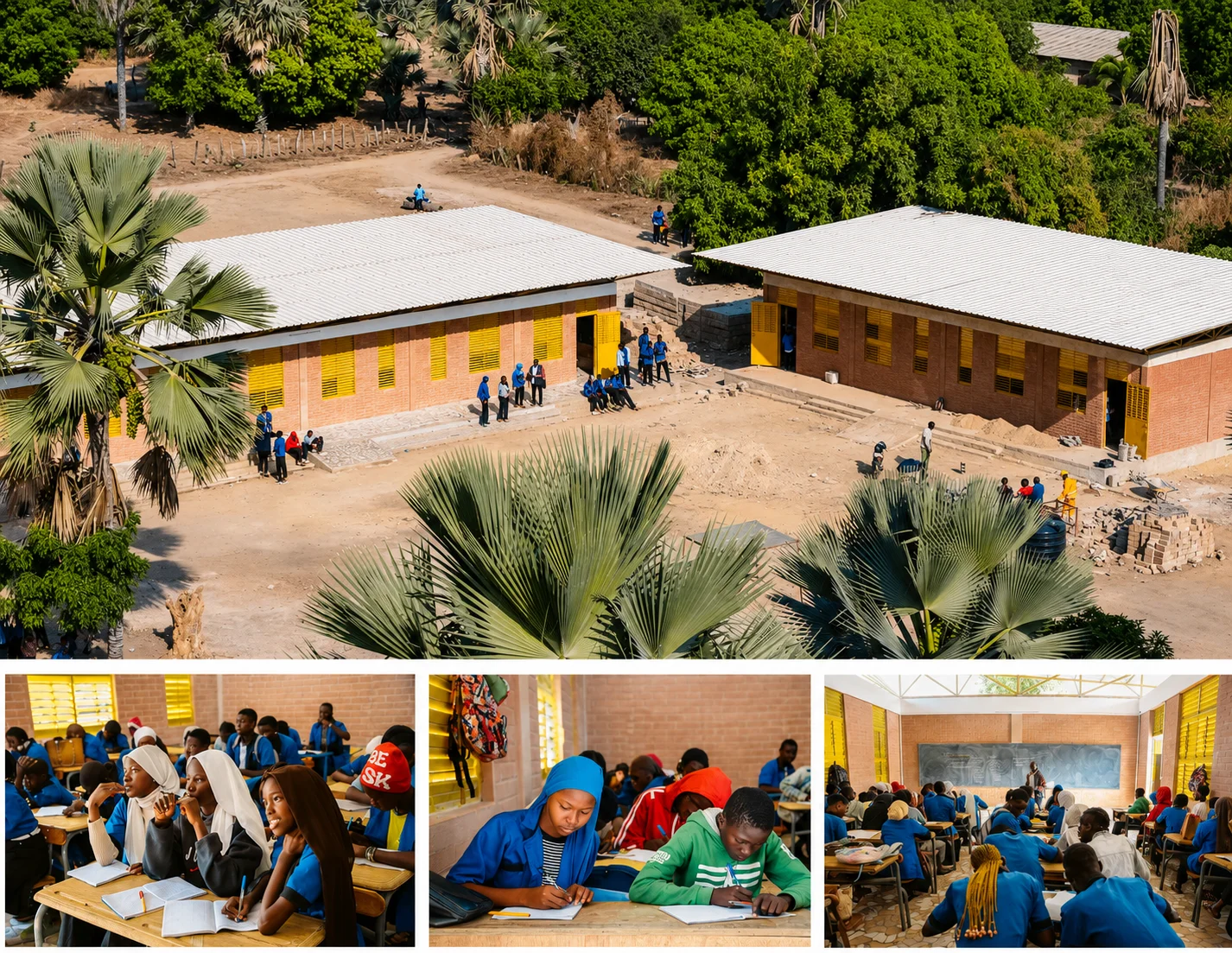
Description
For generations, the centuries-old baobab tree at the entrance to Kabar has been the heart of community life—a place where elders gather, stories are shared, and collective decisions are made. Community Ground builds upon this living tradition, creating a contemporary place where education, cultural continuity, ecological stewardship, and community leadership grow together.
Located between Kafountine and Diannah in Senegal’s Casamance region, the Jola (Diola) community has long sustained its identity through fishing, rice cultivation, communal labor, and deep relationships with the land. Yet more than 17,000 residents rely on a single overcrowded secondary school, where over 1,000 students attend facilities designed for only 400. Beyond limiting education, the shortage of shared learning spaces has weakened opportunities for intergenerational knowledge exchange and community life.
An unexpected 18-month funding delay transformed the project from an international design competition into a community-led process. Through conversations beneath the baobab tree, participatory workshops, mapping, and a Design Game involving more than 100 residents, elders, women, teachers, students, and local partners collectively shaped the school’s organization, gathering spaces, digital learning hub, and future growth.
Community Ground is more than a school. It is a shared civic place where formal education, Indigenous knowledge, lifelong learning, women’s capacity-building, and environmental stewardship reinforce one another. Extending beyond sustainable architecture, the project cultivates a living landscape through local construction, community greening, and ecological restoration, strengthening local capacity so future generations can sustain their culture, restore their environment, and shape their own future.
Stakeholders
Kabar Community Elders & Leaders; Kabar Community Members; Kabar Women & Youth Representatives; Kabar School Administration & Teachers; Kakolum ; Ousmane Diatta ; ACTS Design Group; Korea Architect Association of New York (KAANY); Private Donors
Design Team
Kabar Community Elders & Leaders – Project Advisors; Kabar Women’s Representatives – Project Co-Designers and Advisors; Kabar Student & Youth Representatives – Project Co-Designers; Kabar School Administration & Teachers – Educational Advisors; María Bujons Pié (Kakolum) – Local Director + Implementation Partner + Workshop Facilitators; Ousmane Diatta – On-Site Project Manager + Construction Coordinator; Donghwan Moon (ACTS Design Group) – Lead Design Facilitator / Project Lead; Jong Hwa Lee (ACTS Design Group) – Project Architect; Jee Yeon Han (ACTS Design Group) – Community Partnership Coordinator; North Carolina State University CityLab – Research + Project Advisor
Jury Summary
Community Ground is an exemplary community-centered education project in rural Senegal that transformed an international design competition into a collaborative, locally driven process. Responding to an overcrowded secondary school and limited shared learning spaces, ACTS Design engaged more than 100 residents—including elders, women, students, teachers, and local organizations—through workshops, design games, and consensus building beneath a traditional baobab tree. Community participation materially shaped the school as a civic place where formal education, local knowledge, lifelong learning, and community life reinforce one another. Locally produced compressed-earth bricks, local labor, climate-responsive strategies, tree planting, and educational gardens build skills, strengthen economic and ecological resilience, and turn the landscape into a living classroom. The project reflects I-SEED values of participation, inclusion, cultural continuity, environmental stewardship, capacity, and self-determination. Submitted photographs document engagement and the completed learning environment. However, the application provides limited community-verified evidence of long-term outcomes and could more clearly demonstrate how local worldviews, cultural values, governance traditions, and spatial knowledge directly informed design decisions. Still, Community Ground offers a compelling model of shared ownership.
Detailed Juror Comments
- The community participation materially informed the design decisions, cultural and ecological considerations are integrated into the architecture, and the submitted photographs document participatory activities and the built educational environment. The application provides substantial evidence of process and design intent but comparatively limited community-verified, measurable evidence of long-term outcomes after implementation.
- As its name suggests, Community Ground is solidly rooted in Community! “Community Ground” recognizes that healthy communities are sustained through the enduring relationships between people, culture, and place. The project began by listening to how the Kabar community has gathered, learned, and made decisions for generations. Built with locally produced earth bricks, local labor, and climate-responsive strategies, “the project strengthens environmental stewardship while investing in local knowledge, skills, and economic resilience. More than a school, Community Ground is a shared civic place where formal education, Indigenous knowledge, lifelong learning, and community life reinforce one another. By expanding community ownership and local capacity, the project enables future generations to steward their culture, restore their landscape, and shape their own future.
- This project responds to a tangible community need: an overcrowded secondary school and limited shared learning spaces. Its use of design games as a community engagement tool suggests an accessible and participatory process, similar to the Raleigh Design Trust application. However, the proposal reads more as an Indigenous-led design project than an Indigenous planning or design project grounded in Indigenous epistemologies. While the engagement process is impressive, the application does not explicitly indicate how the community’s worldview, cultural values, or spatial knowledge systems informed the process or outcomes.
- I don’t think I fully understand the intentions of this project.
- Community Ground is a strong example of community-centered public interest design that demonstrates meaningful participation, local capacity building, and environmental stewardship. Although the project is not Indigenous in the North American Tribal sense, it closely aligns with many I-SEED principles through its respect for local cultural knowledge, community governance traditions, and place-based decision-making. The project evolved from an externally initiated design competition into a genuinely collaborative process involving more than 100 community members, including elders, women, students, teachers, and local organizations. This shift toward community-led planning is one of the project’s greatest strengths. Very interesting how funding issues ended up leaving this NOT led by the architects! The project effectively promotes inclusion, social cohesion, and local self-determination through participatory workshops, design games, and consensus-building processes that shaped the final design. The use of locally produced compressed earth bricks, local labor, climate-responsive design, tree planting, and educational gardens demonstrates a strong commitment to environmental stewardship and community resilience. While the project strongly embodies the values of community empowerment and cultural continuity, it is somewhat less directly tied to Indigenous sovereignty, cultural rights, and traditional governance systems than the strongest Indigenous-focused submissions reviewed. Nevertheless, it represents an exemplary model of participatory design and community ownership with lasting social and environmental benefits.
- Strengths: Community Ground is located in Senegal. It entails the redesign of a secondary school. The project began as an international design competition but delays turned into a community driven project. The meetings were held under the community space of a traditional baobab tree. The effort was coordinated by the ACTS Design group involving numerous local stakeholders. School is recognized as the center of the community’s culture. Project uses an Indigenous planning framework utilizing the relationships between people, culture and place. Community participation is part of the design process. Involved more than 100 residents. Building was conceptualized through shared decisions and building relationships. Project built local capacity. Landscape became a living classroom. Seems like a really common-sense approach. Weaknesses: None. Would have liked to see more examples of how local knowledge informed the design.
- The breadth of community led partnership towards the built result is extensive. Process of community ground captures the essence of the process. Local building methods for continuing capacity for future knowledge.